Is This UPI ID Safe?Free UPI Fraud Checker for India
Received a UPI ID to send money? Before you transfer funds, verify it against 10 million reported fraud cases. RakshaAI's AI-powered UPI fraud detector analyses any UPI ID instantly — whether it's a suspicious payment request, refund scam, QR code fraud, or fake merchant.
Whether it's a fake merchant collecting money, an impersonation scam, a QR code fraud, or an OTP-based payment trick — our tool helps you verify any UPI ID and identify dangerous payment targets before it's too late. Enter the UPI ID and get your result in under 5 seconds.
Enter the UPI ID to get an instant fraud risk report
✓ Fraud probability score (0–100) · ✓ Complaint count · ✓ Scam pattern details
Your data is secure. We never store or share the UPI IDs you check.
How to Check If a UPI ID Is Fake
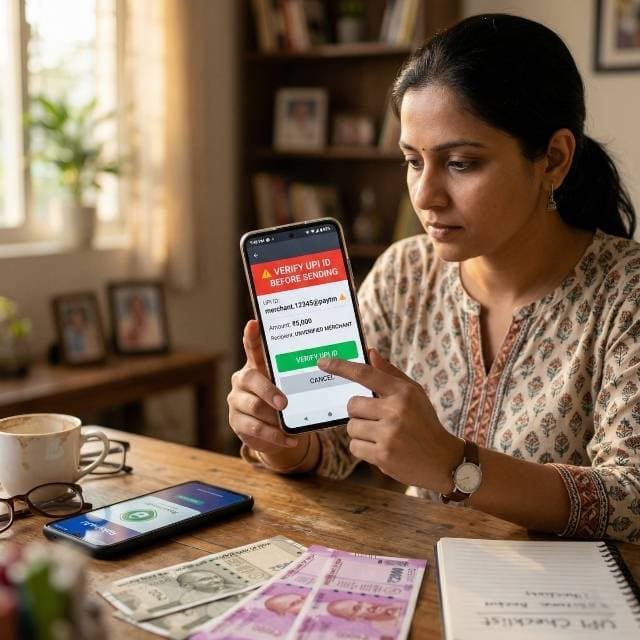
A fake UPI ID is one of the easiest scam tools to create — it takes a scammer under 60 seconds. But spotting one takes even less time if you know what to look for. Here's a three-step approach to verify any UPI ID before you send a single rupee.
Verify the UPI Handle
Every UPI ID ends with a 'handle' that identifies the payment service provider. Legitimate handles come from NPCI-approved banks and apps.
✅ Legitimate UPI Handles (Trust These)
⚠️ Suspicious Handles (Verify Carefully)
Check the UPI ID Pattern
A legitimate UPI ID follows a predictable format: username@bankhandle. Red-pattern UPI IDs stand out once you know what to look for. If the pattern looks unusual, don't send money.
Random numbers with unusual handles
9999888877@xyz — unknown provider
Impersonation patterns
sbi.customercare@upi — banks don't use UPI IDs for customer service
Typosquatted merchant names
flipkartt@upi, amaz0n@pay — one character off
Handles not in NPCI's approved list
Any @suffix not matching a registered PSP
Use RakshaAI's Free Checker
Once you've done a visual check, enter the UPI ID into our tool above. RakshaAI cross-references it against 10M+ reported fake UPI ID cases, checks NPCI's merchant registry, and scans for patterns from known scam networks — results in under 5 seconds, no login required.
UPI Fraud Statistics in India
UPI Scam Cases in 2025–26
According to the Ministry of Home Affairs and NPCI data, UPI fraud accounted for ₹1,087 crore in reported losses in 2025. The number of registered complaints crossed 15 lakh for the year, up 34% from 2024. Importantly, these are only reported cases — fraud researchers estimate the actual figure is 3–4× higher due to under-reporting, particularly in rural areas where victims don't know how to file a complaint.
Most Targeted Cities
Mumbai, Delhi, Bengaluru, Hyderabad, and Pune account for approximately 58% of all reported UPI scam cases. However, Tier 2 cities like Lucknow, Jaipur, Ahmedabad, and Indore are seeing the fastest growth in UPI fraud year-on-year — largely driven by first-time digital payment users who haven't been exposed to fraud awareness.
Most Common Scam Types by Volume (2025)
These statistics underscore why checking a UPI ID before every significant payment is not paranoia — it's common sense. The 5 seconds it takes could protect you from joining the 15+ lakh Indians who filed UPI fraud complaints last year.
Visual Breakdown
How ₹1,087 Crore Was Lost in 2025
Common UPI Fraud Types in India
UPI has transformed how India pays — but it has also transformed how India gets scammed. In 2025, NPCI reported over 1.5 crore fraud-linked UPI payment complaints. Here are the five types you are most likely to encounter.
Wrong UPI ID / Refund Scam
Most common — 31%Scammer 'accidentally' sends you a small amount, then calls asking you to 'return' money to a different UPI ID — which is theirs. The original credit bounces or reverses. You lose your refund amount entirely.
QR Code Scam
Very common — 19%Scammer sends a QR code claiming it will 'transfer money to you' for a refund or prize. Scanning it and entering your PIN sends money out of your account — not into it. UPI QR codes can only send, never receive.
Refund / Cashback Scam
Common — 9%'Your last order is eligible for a ₹500 cashback — re-verify to receive.' Link leads to a fake page that captures your UPI PIN. Real refunds are always processed automatically with no PIN required.
Fake Payment Screenshot
Growing — 14%Sellers receive a convincingly edited payment screenshot before releasing goods. Always verify payment receipt in your own UPI app transaction history — a screenshot is not proof of payment.
OTP-Based UPI Fraud
Devastating — 27%Caller poses as bank customer service or TRAI, asking you to 'approve a verification transaction' by entering your UPI PIN. Your PIN is a sending credential — it is never needed for any incoming purpose.
The Golden Rule — याद रखें
Receiving money via UPI needs NO PIN, NO OTP, NO QR scan, and NO app install. If someone says otherwise — they are stealing from you.
पैसे पाने के लिए कभी PIN, OTP या QR की जरूरत नहीं होती।
4 Steps From UPI ID to Answer
Four simple steps — takes less than 30 seconds to know if a UPI ID is safe to pay.
Enter the UPI ID
Paste any UPI ID in the format name@bank or phone@upi. No sign-up needed.
AI Scans 10M+ Records
We check against community fraud reports, NPCI data signals, cybercrime filings, and cross-bank fraud patterns in real time.
Receive a Fraud Risk Score
A 0–10 risk score with category tags (fake merchant, impersonation, money mule, etc.) and the number of reports against this ID.
Send Safely or Report
Proceed with confidence if clear — or report a fraud ID to protect 2M+ fellow Indians immediately.
What to Do If You've Been Scammed via UPI
Acting within the first 30 minutes gives you the best chance of recovering your money. Every minute matters — here's exactly what to do.
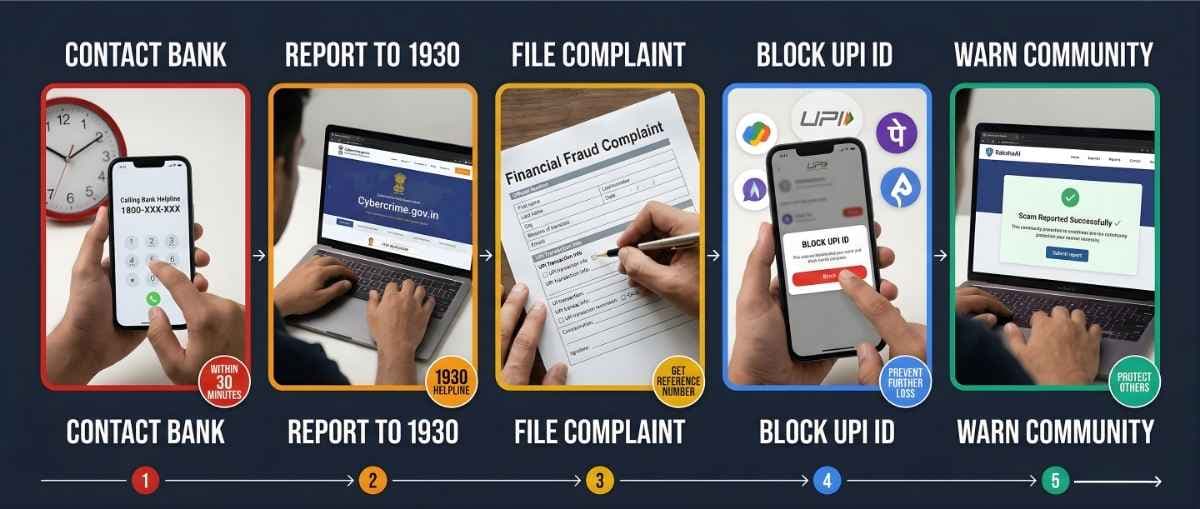
Contact Your Bank Immediately
Call your bank's 24/7 fraud helpline — the number is on the back of your debit card. SBI: 1800-11-2211 · HDFC: 1800-202-6161 · ICICI: 1800-1080 · Axis Bank: 1800-419-5959. State clearly: 'I have been a victim of UPI fraud and need to dispute a transaction immediately.' Ask them to flag the transaction and place a temporary hold.
Report to Cybercrime Helpline 1930
India's National Cybercrime Reporting Helpline 1930 is specifically set up for financial cyber fraud. Call immediately and provide: your name and phone number, the scammer's UPI ID, the transaction ID from your UPI app, the exact amount and time of the transaction, and a brief description of how the fraud occurred. The faster you call, the higher the chance the receiving account gets flagged before funds are withdrawn.
File a Complaint on Cybercrime Portal
Go to cybercrime.gov.in and file a formal complaint under 'Financial Fraud.' You'll need: a screenshot of the fraudulent UPI transaction, the scammer's UPI ID and any communication (messages/calls), your bank statement showing the debit, and any screenshots of the conversation that led to the payment. Save all evidence before filing.
Report to Your UPI App
Open your UPI app and navigate to the transaction. Google Pay: tap transaction → Report a Problem. PhonePe: tap transaction → Raise Concern. Paytm: go to Help → Report Fraud. BHIM: call 18001201740. Most UPI apps process dispute reports within 48–72 hours and share information with NPCI's fraud monitoring systems.
Block the Scammer and Report to RakshaAI
Block the phone number, UPI ID, and any associated social media accounts. Then report the fake UPI ID through RakshaAI's reporting form. Your report is added to our database within 4–6 hours, immediately increasing the fraud score for that UPI ID and protecting the next Indian who checks it before paying.
What is a UPI ID and How Does It Work?
Understanding how UPI IDs work is the first step in protecting yourself from payment fraud.
UPI ID Format Explained
A UPI ID (also called a Virtual Payment Address or VPA) follows the format username@bankhandle — similar to an email address. For example: rohit.sharma@oksbi or 9876543210@ybl.
Key fact:
Your UPI ID is a public identifier — safe to share with anyone who needs to send you money. It only lets people send money to you, never withdraw from your account.
How UPI Payments Work
- 1Enter the recipient's UPI ID in your payment app
- 2Enter the amount you want to send
- 3Authorise the payment with your UPI PIN
- 4NPCI verifies both accounts in real time
- 5Money transfers instantly — 24/7, 365 days a year
✓ Your UPI PIN is only needed when sending money — never to receive it.
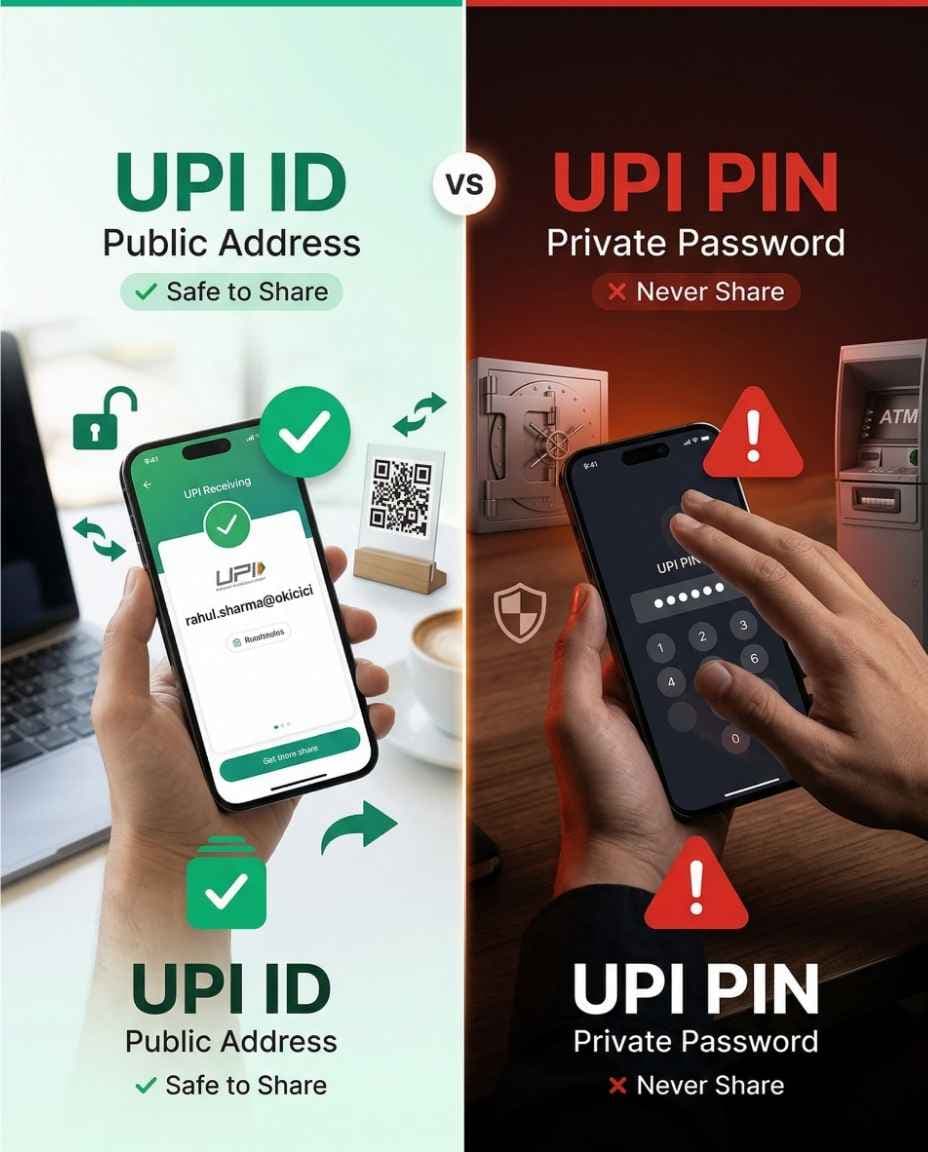
Difference Between UPI ID and UPI PIN
UPI ID — Public Address
- ✓ Like your bank account number
- ✓ Safe to share with anyone sending you money
- ✓ Cannot be used to withdraw from your account
- ✓ Example: name@bankhandle
UPI PIN — Private Password
- ✗ Like your ATM PIN — never share
- ✗ Anyone asking for your PIN is a scammer
- ✗ Only you need to enter it, when sending
- ✗ 4–6 digit secret — guard it absolutely
Legitimate UPI Apps in India
Only use UPI apps from these trusted providers. These are officially registered with NPCI and available on official app stores.
Bank-Backed UPI Apps
Google Pay
PhonePe
Paytm
BHIM
Amazon Pay
Bank-Specific UPI Apps
SBI YONO
@sbi
State Bank of India
HDFC PayZapp
@hdfcbank
HDFC Bank
ICICI iMobile
@icici
ICICI Bank
Axis Mobile
@axisbank
Axis Bank
Kotak Pay
@kotak
Kotak Mahindra Bank
Never download UPI apps from WhatsApp or SMS links
Fake UPI apps sent via WhatsApp or SMS can steal your banking credentials. Always download payment apps exclusively from the Google Play Store or Apple App Store.
Quick Reference
UPI Safety at a Glance
Verify UPI ID first
Never share your PIN
QR only sends money
Use official apps only
Check transaction history
Report fraud at 1930
UPI ID vs UPI PIN — Know the Difference
Your UPI ID is a public address — safe to share with anyone sending you money. Your UPI PIN is your private transaction password — equivalent to your ATM PIN and never to be shared with anyone.
UPI ID — Public Address
- ✓ Safe to share with anyone sending you money
- ✓ Cannot be used to withdraw from your account
- ✓ Like your bank account number
UPI PIN — Private Password
- ✗ Never share — treat like your ATM PIN
- ✗ Anyone asking for your PIN is a scammer
- ✗ Only needed when sending money — never to receive
The Golden Rule — याद रखें
Receiving money via UPI needs NO PIN, NO OTP, NO QR scan. If someone says otherwise — they are stealing from you.
How to Protect Yourself from UPI Scams
Five essential habits that eliminate the majority of UPI fraud risk. Share these with your family.
Never Share Your UPI PIN
Your UPI PIN is the equivalent of your ATM PIN. No bank, NPCI official, payment app support agent, or government body will ever ask you for your PIN. Anyone who does is a scammer — hang up or block immediately.
Verify Before You Pay
Check the registered name shown on your payment app before confirming any transaction. For anything above ₹1,000 or from an unknown contact, run the UPI ID through RakshaAI first. This one habit prevents most fraud.
Check Payment Confirmations Yourself
Never accept a screenshot as proof of payment. Always verify by checking your UPI app's transaction history, your bank's SMS alert, and your actual account balance. Fake payment screenshots look convincing but your bank records don't lie.
Report Suspicious UPI IDs
If you encounter a suspicious UPI ID, report it in three places: (1) use the 'Report' option in your UPI app, (2) file a complaint at cybercrime.gov.in or call 1930, and (3) submit it to RakshaAI to protect other users in real time.
Use Trusted Payment Apps Only
Only download payment apps from the official Google Play Store or Apple App Store. Trusted apps: Google Pay, PhonePe, Paytm, BHIM, Amazon Pay. Never install a 'special' payment app sent to you via WhatsApp, SMS, or a link — these are always fraudulent.
Real vs Fake UPI Handle Guide
Fraudsters create UPI handles that look like official bank addresses. Here's how to spot the difference at a glance.
@okaxis
Axis Bank
@oksbi
State Bank of India
@okicici
ICICI Bank
@okhdfcbank
HDFC Bank
@paytm
Paytm Payments Bank
@ybl
PhonePe (Yes Bank)
@ibl
PhonePe (IndusInd Bank)
@upi
Generic BHIM UPI
@okaxis-support
FAKE — no dashes in real handles
@sbirefund
FAKE — unofficial suffix
@paytm.helpdesk
FAKE — dots not allowed
@icicl
FAKE — typo on ICICI
* Real UPI handles never contain dashes, dots, or extra words after the @bank suffix. When in doubt — check on RakshaAI before sending money.
UPI Red Flags — Spot Them Before You Send
Even without checking the UPI ID, these scenarios should make you stop immediately.
Suspicious UPI Handles
- Generic handles that cannot be traced to a real individual or business
- Merchant name shown in your app doesn't match the payment description
- Handle ends in an unusual suffix not from a recognised payment provider
Urgency and Pressure Tactics
- "Limited time offer" or "transfer within 10 minutes" — this is psychological manipulation
- "Your account will be blocked unless you pay now" — no bank operates this way
- Any pressure to act before you can think, verify, or consult someone
Unusual Payment Requests
- Large amount transfers requested by unknown contacts online
- Advance payment demanded before you can inspect goods or services
- "Test payment" requests — legitimate businesses never require these
Grammar and Language Errors
- Obvious spelling mistakes in messages from supposed bank or government officials
- Poor Hindi transliteration or unusual character substitutions
- Inconsistent language mixing that professional organisations would not use
🚨 Fake UPI ID Red Flags — Quick Reference
- •Handle not from a recognised payment provider
- •Urgent pressure to send money immediately
- •QR code claiming to 'receive' money (always a scam — QR codes only send money)
- •Request to enter UPI PIN for a 'refund' or 'verification'
- •Payment request from unknown contacts for large amounts
- •Fake payment screenshot — always verify in your own app
- •Refund request that asks you to scan a QR code or enter PIN
Frequently Asked Questions
How accurate is the UPI ID scam checker?
Can I check any UPI ID from any bank?
What should I do if I already sent money to a fake UPI ID?
Can someone steal money with just my UPI ID?
Is it safe to scan QR codes from unknown sources?
How do 'refund scams' work on UPI?
How can I verify if a UPI payment was successful?
What is the difference between UPI ID and UPI PIN?
What is UPI One World and who can use it?
Is it safe for NRIs to use UPI from abroad?
How do scammers get my phone number to send UPI requests?
How do I check if a UPI ID is fake or real?
Are fees charged to use the UPI ID checker?
Check Another Safety Tool
UPI scams are just one part of India's cyber fraud problem. Use RakshaAI's full safety suite for comprehensive protection:
Learn About UPI & Payment Scams
Recent UPI Scam Alerts
Stay updated on the latest UPI fraud patterns reported across India.
New Wave of Fake Refund UPI IDs
Scammers impersonating e-commerce refund teams are sending fake UPI IDs via SMS. Over 4,200 cases reported this month alone.
QR Code Scam Surge in Metro Cities
Fraudulent QR codes placed over legitimate payment stickers at shops in Mumbai, Delhi, and Bengaluru. Always verify before scanning.
Fake Cashback Requests Rising
Victims receive calls about 'cashback' that require entering their UPI PIN to claim. Cashback never requires your PIN — this is always fraud.
Spotted a new UPI scam?
Your report goes live within 4–6 hours. Together, 2 million+ Indians are building the most comprehensive UPI fraud database in the country.
About to Send Money?
Spend 5 seconds verifying the UPI ID first. It's free, instant, and could save you from losing your savings.
🇮🇳 Protecting India from the ₹485 Cr UPI fraud epidemic · 100% Free · No sign-up needed